


From Product Traceability to AI Classification: A Koppert Machine Vision Case Study

Machine Vision Applications Beyond Traditional Manufacturing
Machine vision is not limited to traditional industrial manufacturing. Automated image acquisition, product identification, and deep learning technologies can also bring valuable benefits to biological production.
Machine vision is not limited to traditional industrial manufacturing. Automated image acquisition, product identification, and deep learning technologies can also bring valuable benefits to biological production.
For Koppert, a company specializing in biological solutions, Trifid Automation implemented a machine vision system for product traceability and subsequently conducted a feasibility study exploring AI-based classification of bumblebee hives.
Customer Requirements
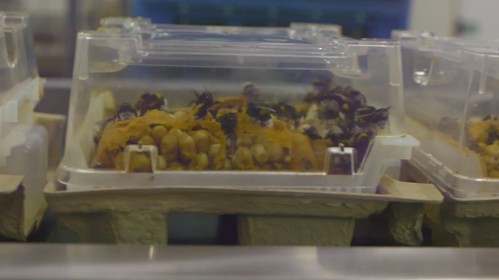
Koppert produces bumblebee hives used for biological pollination. Reliable product identification and traceability are important for maintaining production records, supporting internal research, and addressing potential customer claims.
The main requirements were:
- Automatic image acquisition of product boxes moving on a conveyor.
- Barcode and QR reading for unique product identification.
- Storage of high-quality color images linked to individual barcodes.
- Image archiving on the customer's servers for traceability, internal research, and future analysis.
In a separate project, Koppert also wanted to investigate the possibility of classifying bumblebee hives into different family categories using machine vision and deep learning. Correct classification is important to help prevent the unintended mixing of families and reduce potential impacts on local fauna.
Challenges
The main challenge was obtaining clear, high-quality images while the product boxes were moving on the conveyor.
Bumblebee hives are enclosed in boxes with transparent plastic covers. Reflections from these covers can reduce image quality and make it difficult to capture the hive clearly.
The inspection system therefore had to address:
- Conveyor speed and reliable image acquisition during production.
- Glare and unwanted reflections from transparent plastic covers.
- Sufficient image quality for traceability and subsequent image analysis.
Solution
1. Automated Product Traceability
Trifid Automation integrated an industrial Cognex color camera into the existing conveyor line.
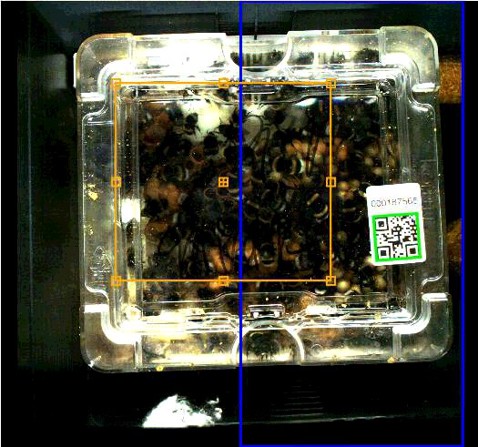
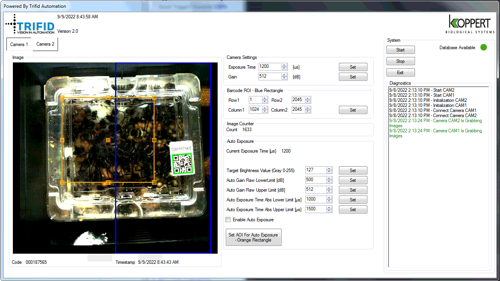
As each product box passes the camera station, the system captures a high-quality color image and reads the barcode on the box. Using machine vision software based on MVTec HALCON, the captured image is associated with the product's unique barcode.
The image is saved with the barcode as its filename, allowing Koppert to archive the photographs on its servers and retrieve them for internal research, product analysis, or investigation of customer claims.
To improve image quality, the system uses industrial linear lighting from Smart Vision Lights, together with a MidOpt optical filter to reduce unwanted glare from the plastic cover.
2. AI-Based Bumblebee Hive Classification — Feasibility Study
Building on the existing image acquisition system, Trifid Automation conducted a separate feasibility study to investigate whether bumblebee hives could be classified into family categories based on their visual appearance.
Using MVTec HALCON Deep Learning Tool, the study explored the potential of artificial intelligence to identify differences between hive families from the captured images.
The initial results were promising and demonstrated the potential of deep learning for this type of classification task.
The project remained at the feasibility study stage and was not implemented as an automated production classification system.
Main Hardware Components
- Industrial camera: Cognex color camera
- Lighting: Smart Vision Lights industrial linear light
- Optical filter: MidOpt filter for glare reduction
- Industrial computer: Neousys Nuvo-9000 series
Deep Learning Feasibility Study — Computing Platform:
- AI computing platform: Neousys Nuvo-8208GC GPU Computing AI Platform
- Processor: Intel® Xeon® E-2278GE CPU @ 3.30 GHz
- Memory: 64 GB RAM
- Graphics card: NVIDIA GeForce RTX 2080 SUPER with 8 GB VRAM
Main Software Components
- MVTec HALCON: Industrial image processing and barcode reading
- MVTec HALCON Deep Learning Tool: Evaluation of AI-based hive classification
- Custom Trifid Automation software: Image acquisition, barcode-based file naming, and integration with the image archiving workflow
Results
Implemented Traceability System
- Automated image capture and barcode identification on the existing conveyor.
- High-quality color images of individual product boxes.
- Images stored under their corresponding barcode identifiers.
- Improved product traceability and availability of photographic records for internal research, product analysis, and customer claim investigations.
AI Classification Feasibility Study
- Exploration of deep learning for distinguishing bumblebee hive families.
- Promising initial results supporting further investigation.
- Demonstration of the potential to extend existing machine vision applications with AI-based analysis.
Conclusion
The Koppert projects demonstrate how machine vision can provide practical benefits beyond conventional manufacturing applications.
By combining industrial imaging hardware from Cognex, Smart Vision Lights, and MidOpt with MVTec HALCON software, Trifid Automation delivered a traceability solution and explored additional possibilities using deep learning.